How to Build Your Confidence Again When Life Has Knocked You Off Course
- Lisa Sewards

- Aug 18
- 5 min read
There are times when confidence seems to disappear without you quite knowing when it happened.
Perhaps something has changed in your life. A relationship has ended, your career has taken an unexpected turn, the children have left home, or you have simply reached a point where the life you once felt comfortable with no longer feels quite right. You may still be getting on with everything you need to do, but underneath it all there is a growing sense of self-doubt.
You might find yourself questioning decisions you would once have made quite easily, worrying more about what other people think or comparing your life with everyone else's. You may even wonder where the old, more confident version of yourself has gone.
The good news is that confidence isn't something you either have or don't have. It changes throughout our lives. And when it has taken a knock, it can be rebuilt.

What happens when we lose confidence?
We often think of confidence as a personality trait. Some people are naturally confident; others are not. But confidence is far more complicated than that.
You can be confident in your career but uncertain in your relationships. You can be perfectly capable of handling a crisis for everyone else while struggling to make a decision about your own life. You can have achieved a great deal and still find yourself wondering whether you are good enough.
Confidence is closely connected to self-belief and self-trust. When something happens that makes us question our judgement, our abilities or our sense of who we are, confidence can gradually begin to erode.
Sometimes it is one major event. Sometimes it is years of putting other people's needs first, dealing with criticism, comparing yourself with others or living according to what you believe you should be doing.
Understanding what has affected your confidence is often the first step towards changing it.
Building confidence starts with trusting yourself again
One of the biggest mistakes we can make is waiting until we feel confident before doing something.
We tell ourselves that we will apply for the job when we feel ready, have the difficult conversation when we feel stronger or make the change when we are more certain.
But confidence often works the other way around. We take the step, discover that we can cope, and that experience gives us a little more confidence for the next step.
You don't have to make a huge change overnight. In fact, small decisions can be surprisingly powerful.
Choose what you actually want for dinner. Say what you really think. Make a decision without asking five people whether they agree. Say no when something doesn't work for you. Take yourself seriously.
Every time you do something that reinforces the message I can trust myself, you are rebuilding self-belief.
What does your inner voice sound like?
When confidence is low, our internal dialogue can become particularly unforgiving.
A mistake becomes I'm useless. A rejection becomes I'm not good enough. Seeing somebody else's success becomes I'm falling behind.
It is worth noticing how quickly we turn an individual event into a judgement about ourselves.
Would you speak to a close friend in the same way?
Probably not.
This doesn't mean replacing every negative thought with forced positivity. It means becoming more curious about your own thinking. Instead of automatically believing I'm not good enough, ask yourself what evidence you actually have for that conclusion.
Sometimes confidence begins to return when we stop treating every self-critical thought as a fact.
Confidence, boundaries and relationships
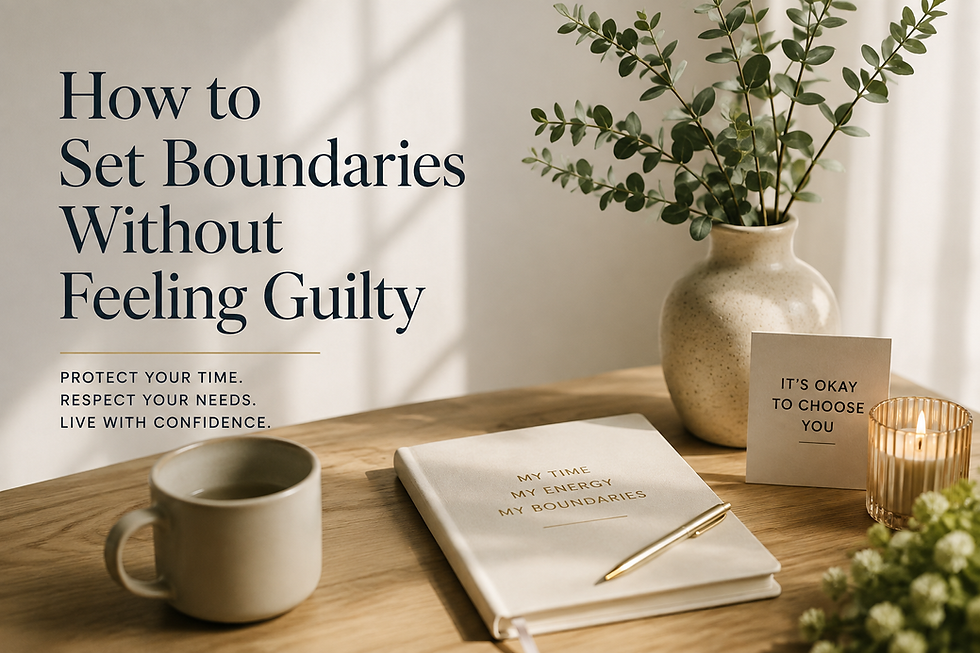
There are also times when what looks like a confidence problem is really a boundaries problem.
If you regularly say yes when you mean no, worry about disappointing people, avoid difficult conversations or put everyone else's feelings before your own, it can become difficult to know what you actually want.
Healthy boundaries aren't about becoming selfish. They are about recognising that your needs matter too.
Being able to say, “That doesn't work for me,” without feeling that you have to provide a ten-minute explanation can be a significant step towards greater self-confidence.
Relationships can have a profound effect on how we see ourselves. So can the patterns we repeat within them. Sometimes gaining clarity about those patterns is just as important as working on confidence itself.
What if you've lost confidence after a major life change?
Career changes, redundancy, retirement, separation, becoming a parent or reaching a new stage of life can all leave us questioning who we are.
When a familiar role disappears, our confidence can sometimes disappear with it.
You may have spent twenty years knowing exactly what you did, what you were good at and where you fitted in. Suddenly, you are having to work out what comes next.
This is where personal development is not about becoming a completely different person. It can be about understanding yourself more clearly and deciding what you want the next chapter to look like.
You don't need to have the whole future worked out.
You may simply need enough clarity to see the next step.
Confidence isn't about becoming someone else
I don't think confidence means becoming louder, more outgoing or more certain than you naturally are.
For some people, confidence is quiet.
It is being comfortable with your own decisions. It is trusting your instincts. It is being able to disagree without feeling threatened. It is knowing your boundaries. It is being willing to make a mistake without believing that the mistake defines you.
Ultimately, it is about feeling secure enough in yourself that you don't constantly need somebody else to tell you that you're doing the right thing.
That kind of confidence tends to be much more lasting.
How life coaching can help
My approach to life coaching has been strongly influenced by more than 30 years as a journalist and feature writer. I have spent much of my career listening to people, asking questions and trying to understand what sits beneath the story they are telling.
As a feature writer for the Daily Mail Weekend Magazine, I have interviewed a wide range of public figures and written about subjects including confidence, identity, relationships, resilience, ambition, pressure and reinvention. Those themes appear again and again because, beneath very different lives, many of us are dealing with remarkably similar questions.
That experience naturally feeds into my work as a life coach.
“I cut to the chase. I ask the laser question. I spot the subtext.”
Coaching isn't about me telling you what to do. It is about creating a calm, confidential space where you can step back from the noise, look at what is really happening and explore what you genuinely want.
Sometimes the issue isn't simply a lack of confidence. It might be a difficult relationship, a career transition, uncertainty about the future, overthinking, perfectionism or simply not knowing which direction to take.
That is why my coaching work brings together confidence and core stability, relationships and boundaries, clarity and direction, and momentum and growth.
“Extraordinary and profound change happens when we feel understood, able to be authentic and explore our story.”
You don't have to arrive with a perfectly formed plan. Sometimes the starting point is simply recognizing that something no longer feels right.
And sometimes, rebuilding your confidence starts with one honest conversation.
Sometimes clarity begins with one honest conversation.
If you're feeling stuck, questioning yourself or wondering what your next chapter might look like, you can find out more about my approach to life coaching, my coaching programs and how we could work together on my website.
Let's rewrite the story you're living and bring out the star in you.


Comments